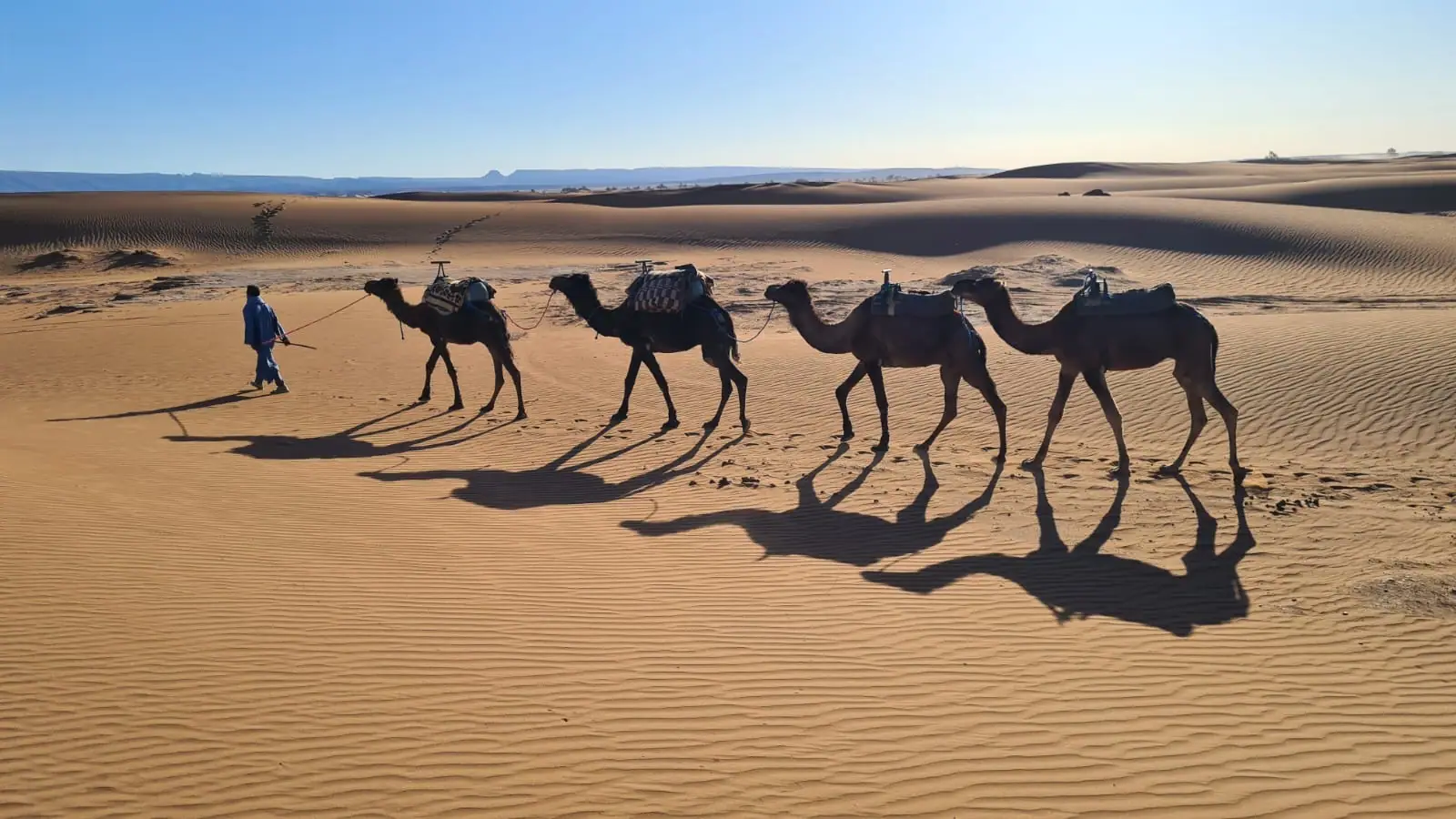
 Camel trek
3-day camel trek to Erg Lmhazil
The shortest true camel trek: palm grove, Jebel Bani, El Mhazil dunes and Lake Iriki in three days on foot.
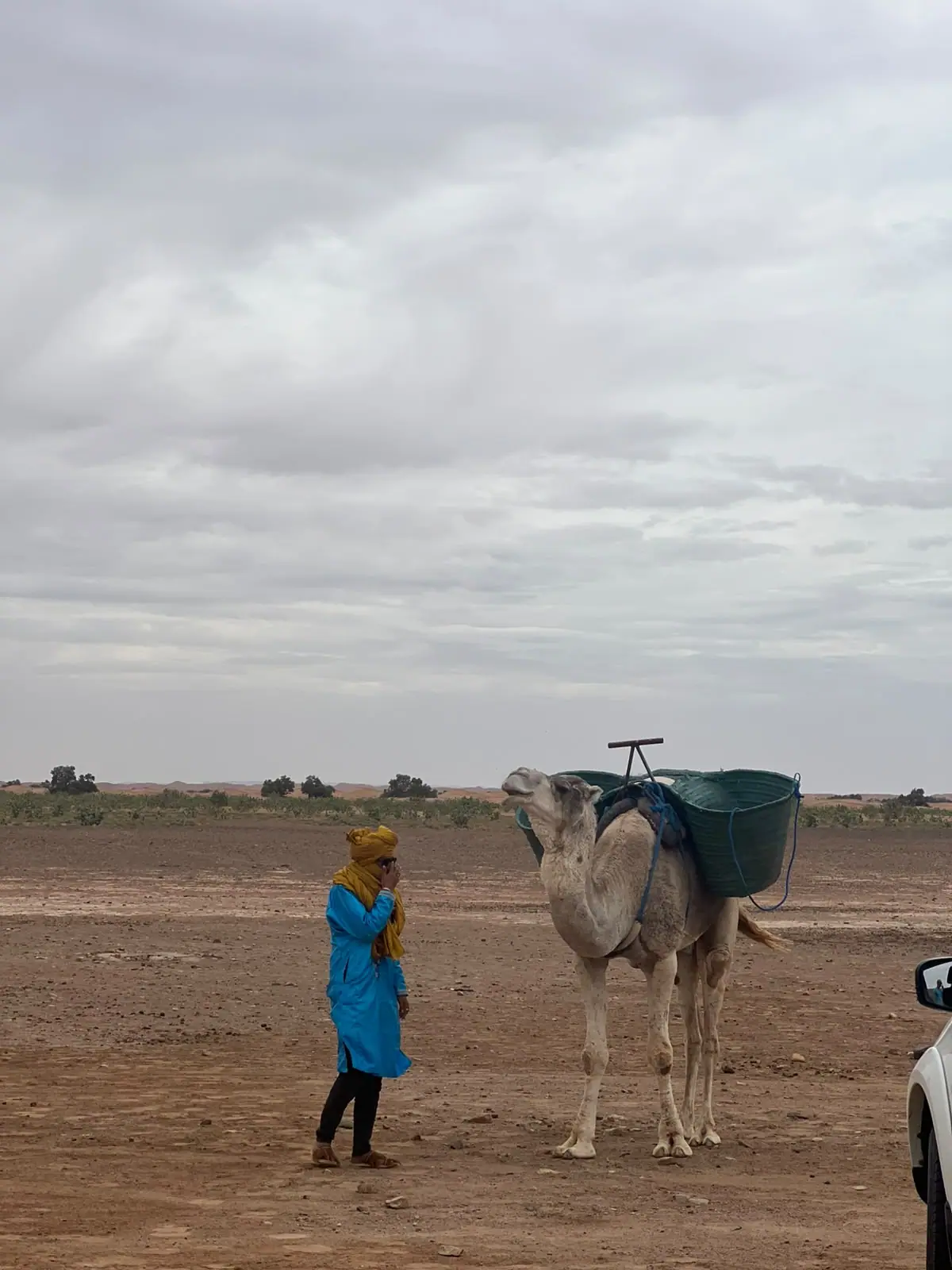
Dromedary vs camel is a question of humps and of words: the dromedary is the one-humped camel, and it is the only kind you will meet, ride or walk beside in Morocco’s desert.
In short
A dromedary is a camel: it is the one-humped species, Camelus dromedarius, also called the Arabian camel. The Bactrian camel of Central Asia has two humps. Every camel in Morocco is a dromedary, so on a trek from Foum Zguid the animals carrying your kit, and the one you may ride for part of a stage, all have a single hump.
The dromedary vs camel question sounds like a choice between two animals, yet a dromedary is simply one kind of camel. The living camels share a single genus, Camelus. Within it, the dromedary (Camelus dromedarius, named by Linnaeus in 1758) carries one hump and also goes by the names Arabian camel and one-humped camel. The Bactrian camel (Camelus bactrianus) carries two.
Calling a dromedary a camel is therefore correct, only less precise. Part of the muddle comes from French, the language of many trip descriptions for Morocco. In everyday French, chameau is used loosely for both animals, while the species French speakers usually mean by chameau is the two-humped one. Read a French programme word for word and you might expect two humps; out here you will only ever see one.
When people put the words dromedary and camel together, they usually mean the dromedary and the Bactrian, the two domestic species. Here is how they compare on published reference figures:
| Feature | Dromedary | Bactrian camel |
|---|---|---|
| Humps | One | Two |
| Scientific name | Camelus dromedarius | Camelus bactrianus |
| Range | First domesticated in southern Arabia; Africa now has more than 80 % of all dromedaries; feral herds in Australia | Steppes of Central Asia, above all the Gobi Desert |
| Height at the shoulder | Males 1.8–2.4 m, females 1.7–1.9 m | About 1.6–1.8 m |
| Weight | Males 400–690 kg, females 300–540 kg | 300–1,000 kg: the largest living camel |
| Climate | Hot desert; it saves water by letting its body temperature rise by day | A coat that copes with −30 °C up to +50 °C |
| Numbers | More than 80 % in Africa; about 106,000 camelids counted in Morocco in 2025 | Roughly 2 million, mostly domestic |
| Still wild? | No: functionally extinct in the wild for some 2,000 years | A separate wild species, Camelus ferus, survives |
Two contrasts stand out. The dromedary is the taller animal at the shoulder, while the Bactrian is the heavier one. And only the two-humped line still has a truly wild relative: Camelus ferus is the one wild camelid left in the Old World. For a trip to Morocco you can leave the Bactrian out of the picture, since it belongs to the steppes of Central Asia rather than to the Sahara.
It is the most repeated idea about camels, and it is wrong. A dromedary’s hump is a store of fat bound together by fibrous tissue; in a well-fed animal it can hold as much as 36 kg or so. There is no reservoir of water inside it.
The myth survives because the endurance is real and the hump is the obvious thing to give the credit to. The true explanation lies in how the rest of the body manages water and heat, which is what the next section is about.
Put a dromedary camel on the stony plains south of the Jebel Bani in the heat of the day and several features work together. None is mysterious: each one either saves water or keeps sand and glare out.
That walking speed is the detail that matters most to a trekker. Four kilometres an hour is an unhurried human pace, so walkers and a loaded caravan can keep each other company all day. Our camel trekking tips explain how a walking day is paced around the heat.
The species breeds slowly. A pregnancy lasts more than a year, 13 to 15 months depending on the source, and usually produces a single calf. A dromedary can live for 25 to 40 years.
People domesticated the dromedary in the south of the Arabian Peninsula, roughly between 4000 and 3000 BC. Wild dromedaries have been functionally extinct for about two millennia, so every animal alive today comes from domestic stock. That includes the feral herds that roam Australia, descended from animals brought there from 1840 onwards.
North Africa is a later chapter. The dromedary was reintroduced to the region around the beginning of the Christian era. Today Africa is home to more than 80 % of the world’s dromedaries, a measure of how firmly the animal took root on this side of the Red Sea.
The two domestic species can also be crossed. Dromedary × Bactrian hybrids are fertile and grow bigger and stronger than either parent. None of this touches the caravans of southern Morocco, where only one-humped animals are kept.
Every Moroccan camel is a dromedary. If an advert for a Moroccan desert trip shows a two-humped animal, the photo was taken somewhere else.
The latest national livestock census, run from 26 June to 11 August 2025, counted about 106,000 camelids. That is well below the figure of around 150,000 usually recorded, and the drop was put down to several drought years in a row.
Herding is concentrated in the south. A field survey by the French research centre CIRAD sampled camel herds in these provinces:
Tata on that list will not surprise anyone who has walked south from Foum Zguid, over gravel and then into the sand of Erg El Mhazil. Our guide to the desert around Foum Zguid describes the ground the caravans cross, and the Sahara trekking overview places it in the wider desert.
Whichever word you prefer, camel or dromedary, the animals in our caravans have one hump. Their main work is carrying: bags, water, food and the camp itself travel on their backs, so you walk with no more than a daypack. Cameleers lead them on foot from start to finish.
Nobody expects you to ride the whole way, or to walk the whole way either:
All six routes, from three to seven days, are on our Morocco camel trekking tours page. When you have chosen, send us your dates on WhatsApp; the programme and price are confirmed with you before anything is booked.
Camel trekThe shortest true camel trek: palm grove, Jebel Bani, El Mhazil dunes and Lake Iriki in three days on foot.
Camel ride on requestOne night in quieter dunes than Erg Chigaga, with an optional camel ride at the camp. From €140.
Camel trekFrom a riad in Foum Zguid to the Chegaga dunes and Erg El Ghoule, with short daily walks. From €650.
No. Every camel kept in Morocco is a dromedary, the one-humped species. The two-humped Bactrian camel is native to the steppes of Central Asia, above all the Gobi Desert, and is not part of Moroccan herds. On any desert trip in the country, the animal carrying bags or riders will have a single hump.
Yes. The dromedary, Camelus dromedarius, is one of the species in the camel genus, next to the two-humped Bactrian. Camel is a perfectly correct name for it, just a broader one. Arabian camel and one-humped camel are two other common names for exactly the same animal.
No. The hump is fat held in shape by fibrous tissue, and a dromedary’s can weigh up to about 36 kg. Its long spells without drinking come from elsewhere: it tolerates losing over 30 % of its body water, drinks huge amounts once it finds water, and avoids sweating by letting its temperature climb.
It depends on the heat. At 30 to 40 °C a dromedary typically drinks every 10 to 15 days, and in the very hottest weather every 4 to 7 days. When it does reach water it can drink up to 114 litres in a single session, at 10 to 20 litres per minute.
Measured at the shoulder, male dromedaries stand about 1.8 to 2.4 m and females 1.7 to 1.9 m. Males weigh roughly 400 to 690 kg, females 300 to 540 kg. The Bactrian is lower at the shoulder, about 1.6 to 1.8 m, yet can be far heavier, up to around 1,000 kg.
Yes. Crosses between the two produce fertile hybrids that are larger and stronger than either parent. Moroccan herds are made up of dromedaries only, so you will not meet such hybrids here. Separate from both is the wild Bactrian camel, Camelus ferus, which is classed as a species of its own.
At its normal walk a dromedary covers about 4 km/h, close to the speed of a steady hiker, which is why trekkers and a loaded caravan can travel side by side. It jogs at 8 to 12 km/h and can run at 14 to 19 km/h, but a trekking caravan keeps to a walk.
You can. On the 3-day Erg El Mhazil trek, from €240 per person, each traveller has a camel and a cameleer travels with the caravan, so you decide when to walk and when to ride. On the longer treks the dromedaries mainly carry the kit, and riding part of a stage is arranged on request.
Write on WhatsApp with your dates, the number of travellers and the trip that tempts you. Nothing is booked until you agree.